Close
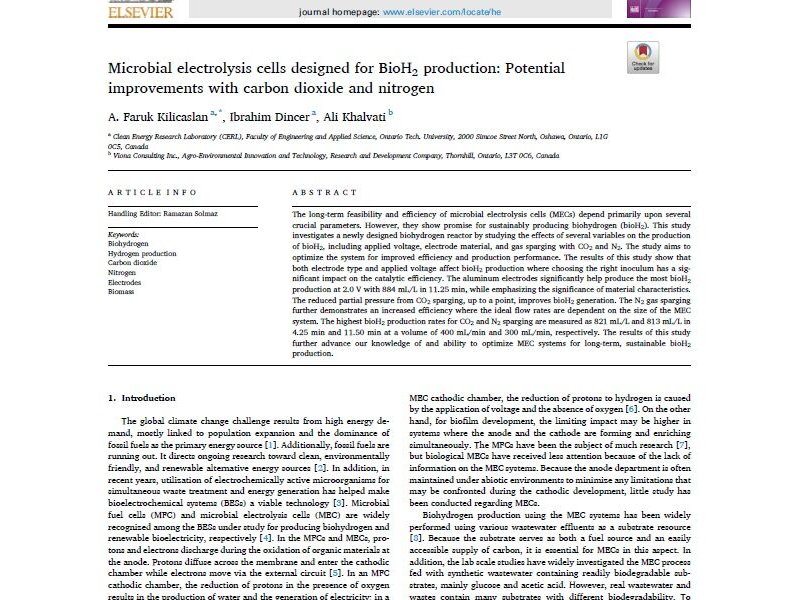
The long-term feasibility and efficiency of microbial electrolysis cells (MECs) hinge on key parameters, showing potential for sustainable biohydrogen (bioH2) production. This study explores a newly designed biohydrogen reactor by analyzing the effects of applied voltage, electrode material, and gas sparging with CO2 and N2, aiming to optimize system efficiency and performance.
Results indicate that electrode type and applied voltage significantly influence bioH2 production, with the choice of inoculum playing a crucial role in catalytic efficiency. Aluminum electrodes yielded the highest bioH2 production of 884 mL/L at 2.0 V within 11.25 minutes, highlighting the importance of material characteristics. CO2 sparging reduced partial pressure, enhancing bioH2 generation up to an optimal point. Similarly, N2 gas sparging improved efficiency, with ideal flow rates depending on MEC system size.
The highest bioH2 production rates were achieved with CO2 sparging at 821 mL/L in 4.25 minutes (400 mL/min) and N2 sparging at 813 mL/L in 11.50 minutes (300 mL/min). These findings contribute to advancing MEC systems for long-term, efficient, and sustainable bioH2 production.