
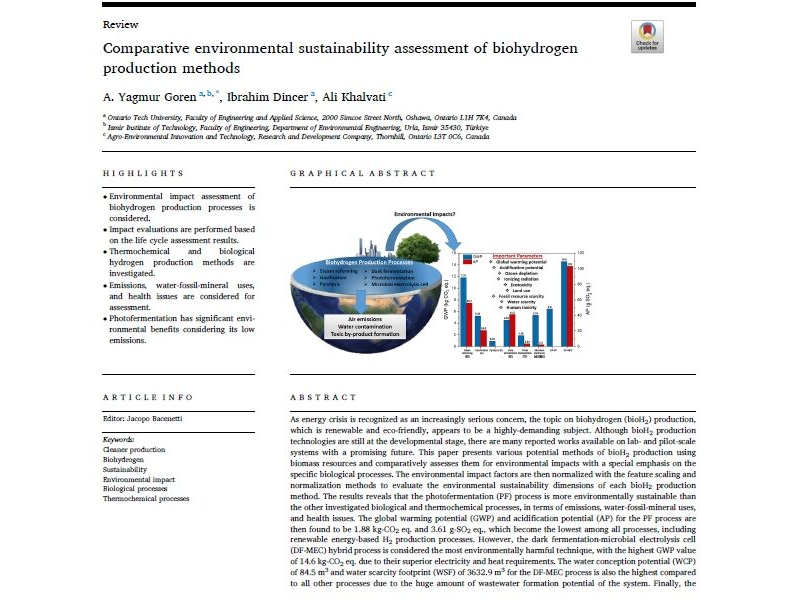
As the energy crisis becomes an increasingly serious concern, biohydrogen (bioH₂) production, which is renewable and eco-friendly, has emerged as a highly sought-after topic. Although bioH₂ production technologies are still in the developmental stage, many reported studies on lab- and pilot-scale systems show a promising future.
This paper presents various potential methods of bioH₂ production using biomass resources and assesses them comparatively for environmental impacts, with a special emphasis on biological processes. The environmental impact factors are normalized using feature scaling and normalization methods to evaluate the environmental sustainability of each bioH₂ production method.
The results reveal that the photofermentation (PF) process is more environmentally sustainable than other investigated biological and thermochemical processes, in terms of emissions, water, fossil, and mineral usage, as well as health impacts. The global warming potential (GWP) and acidification potential (AP) for the PF process are found to be 1.88 kg-CO₂ eq. and 3.61 g-SO₂ eq., respectively, making it the most sustainable option among all processes, including renewable energy-based H₂ production processes.
However, the dark fermentation-microbial electrolysis cell (DF-MEC) hybrid process is considered the most environmentally harmful technique, with the highest GWP value of 14.6 kg-CO₂ eq. due to its significant electricity and heat requirements. The water consumption potential (WCP) of 84.5 m³ and water scarcity footprint (WSF) of 3632.9 m³ for the DF-MEC process are also the highest, attributed to the large amount of wastewater formation potential of the system.