
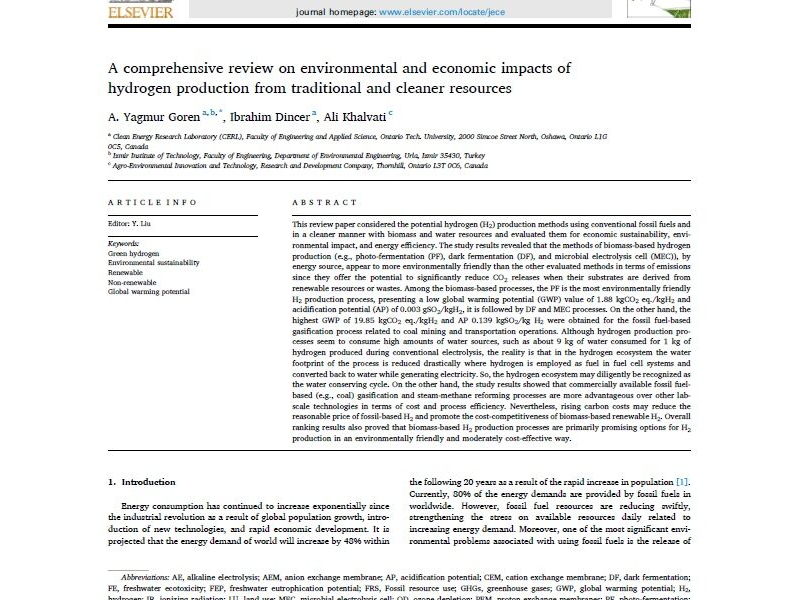
This review evaluated hydrogen (H2) production methods from fossil fuels, biomass, and water, assessing their economic, environmental, and energy impacts. Biomass-based methods, such as photo-fermentation (PF), dark fermentation (DF), and microbial electrolysis cell (MEC), were found to be more environmentally friendly, with PF showing the lowest global warming potential (1.88 kgCO2 eq./kgH2) and acidification potential (0.003 gSO2/kgH2). In contrast, fossil fuel-based gasification exhibited the highest environmental impact, with 19.85 kgCO2 eq./kgH2 and 0.139 kgSO2/kgH2 due to coal mining and transport.
Although hydrogen production consumes water (e.g., 9 kg of water per 1 kg of H2 via electrolysis), the hydrogen ecosystem significantly reduces the water footprint as H2 converts back to water in fuel cells. Fossil fuel-based methods, like gasification and steam-methane reforming, remain more cost-efficient at scale, though rising carbon costs may enhance the competitiveness of biomass-based H2. Biomass-based processes are promising for sustainable and moderately cost-effective H2 production.